


menu 919-999-0831

Understanding Peptide Therapy

Peptides are often discussed in wellness and biohacking communities and are one of the fastest growing areas in integrative and functional medicine. However, not all peptides are created equal. Some are FDA-approved medications backed by large clinical trials, while others are experimental compounds with limited human data.

Understanding the difference is critical for making safe, informed decisions about your care.

The human body, and the bacteria in our bodies, produce thousands of peptides. Peptides are powerful, short chains of amino acids that act like signaling molecules in the body, supporting healing, metabolism, and hormone balance. Researchers have known about peptides for decades and over 60 are currently FDA approved for use [4]. In functional medicine, they’re gaining popularity for root-cause wellness, but not all are equal.

FDA-approved peptides undergo rigorous testing in large clinical trials for safety, dosing, and efficacy. The FDA ensures consistent manufacturing and monitors side effects.

Common examples:

• GLP-1 agonists (e.g., semaglutide/Ozempic® or tirzepatide/Zepbound®): Used for type 2 diabetes, sleep apnea, and weight loss by mimicking gut hormones to regulate blood sugar [1,2].

• Teriparatide (Forteo®): Builds bone for osteoporosis [3].

• Leuprolide(Lupron®): Hormone therapy for prostate cancer or endometriosis [3].

Non-FDA-approved peptides (compounded or research-grade) lack this oversight. They’re not tested in humans for specific uses and are sourced from laboratories or compounding pharmacies with variable purity and potency risks. Batch testing has shown a wide variety of potency and contamination between supplies.

Common types:

• BPC-157: Gut healing, tissue repair (investigational)

• Thymosin Beta-4: Wound healing, inflammation

• Ipamorelin/CJC-1295: Growth hormone support for anti-aging and muscle recovery

These peptides are sometimes used off-label in integrative clinics for longevity or injury support, but evidence remains preliminary. Many of the proposed benefits are extrapolated from rodent studies, and the long-term effects in humans remain largely unknown [5].
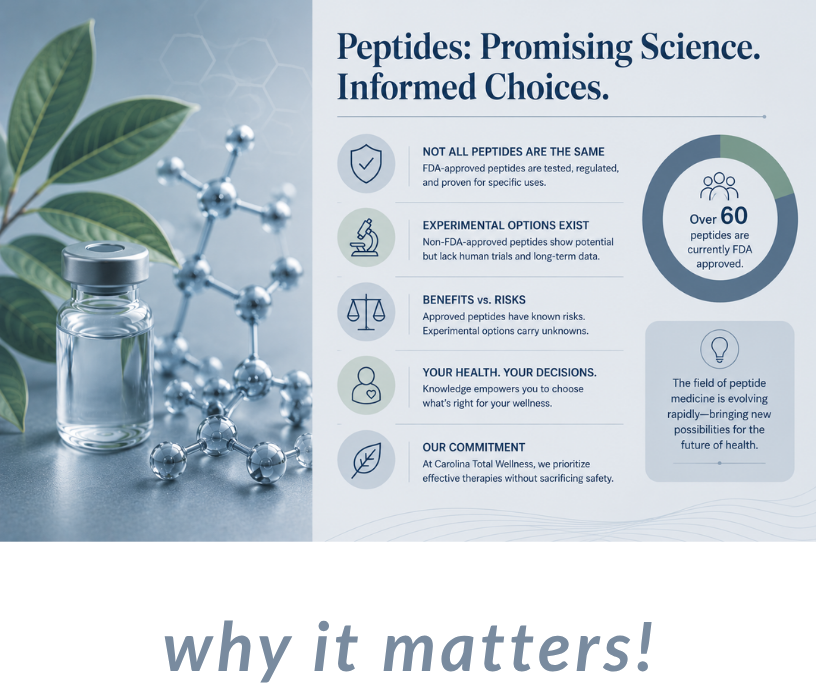
Approved peptides offer proven benefits with known risks. Non-approved peptides may help symptoms but can also carry risks related to contamination, adverse effects, inconsistent dosing, or unknown long-term outcomes.

For example, one proposed mechanism behind BPC-157 is angiogenesis, or new blood vessel formation. While angiogenesis may support healing, it may also theoretically increase cancer growth in certain settings.

Bottom Line —

Peptides are a promising and rapidly emerging area of medicine, and we expect to see many more become FDA-approved in the coming years [6]. However, the use of experimental, non-approved peptides carries meaningful risks.

At Carolina Total Wellness, we strive to guide patients toward evidence-based therapies and strategies that support health optimization without sacrificing safety.

References

  • Musaimi OA, Shaer DA, et al. 2017 FDA peptide harvest. Pharmaceuticals. 2018.
  • Musaimi OA, Shaer DA, et al. 2020 FDA tides (peptides and oligonucleotides) harvest. Pharmaceuticals. 2021.
  • Zhang H, Chen S. Cyclic peptide drugs approved in the last two decades (2001–2021). 2021.
  • Ji X, Nielsen AL, Heinis C. Cyclic peptides for drug development. 2023.
  • Newman D, Cragg G. Natural products as sources of new drugs over the nearly four decades from 1981–2019. 2020.
  • Papapetropoulos A, Topouzis S, et al. Novel drugs approved by the EMA, FDA, and MHRA in 2023. 2024.
  • Gattu R, Ramesh SS, et al. Peptide-bioactive hybrid molecules in infectious disease therapeutics. 2023.
  • Ayala-Aguilera CC, Valero T, et al. Small molecule kinase inhibitor drugs (1995–2021). 2021.
  • Péczka N, Orgován Z, et al. Electrophilic warheads in covalent drug discovery. 2022.
  • Dalton SE, Pietro OD, Hennessy E. FDA-approved small molecule drugs with covalent mechanisms of action. 2025.


The GLP-1 Connection: Boosting GLP-1 Naturally through Microbiome Mastery

Your gut microbiome is a pivotal player in your overall metabolic health. One of its significant roles involves influencing the production of glucagon-like peptide-1 (GLP-1), a hormone integral to regulating blood sugar, insulin secretion, appetite, and weight management. In developed countries such as ours, factors including the Western diet, physical inactivity and chronic stress contribute to depletion of the microbes that stimulate GLP-1 production. But all is not lost, keep reading for dietary and lifestyle ways to replenish your microbiome and improve your metabolic health.

Key Microbial Allies

If you are a Carolina Total Wellness patient, your doctor may have asked you to submit a stool test to assess the presence of various specific microbes in your GI tract. Recent research shows that certain gut bacteria are particularly influential in promoting GLP-1 secretion.

Three ways these tiny creatures influence GLP-1 production:

  • Fermenting the fiber you eat to produce short-chain fatty acids (SCFAs) and stimulate GLP-1 secretion by intestinal cells.
  • Modulating bile acids. Increasing levels to promote GLP-1 secretion.
  • Increasing GLP-1 receptor sensitivity, thereby improving the hormone’s ability to regulate glucose metabolism and appetite.

Several keystone bacteria are known ‘influencers’ when it comes to the above processes. Some you may look for on your stool test results include Akkermansia muciniphila, Bacteroides thetaiotaomicron, Faecali- bacterium prausnitzii and Lactobacillus. Akkermansia is especially known for its role in supporting GLP-1 production. Check out last week’s newsletter from our own Dr. Miraloglu to learn more about Akkermansia.

Functional Strategies to Enhance GLP-1 Naturally

To support natural GLP-1 production through microbiome modulation, consider the following approaches:

  • Increase Prebiotic Fiber Intake: Foods rich in soluble fiber, such as oats, asparagus, garlic, onions, microgreens, flaxseeds, legumes, and sweet potatoes, serve as prebiotics, nourishing beneficial gut bacteria and promoting short chain fatty acid production (SCFA).
  • Incorporate Fermented Foods: Regular consumption of fermented foods like yogurt, kimchi, and sauerkraut introduces beneficial microbes that can support gut health and GLP-1 secretion.
  • Supplement Wisely: Specific probiotic supplements can ‘seed’ your microbiome with akkermansia and other beneficial bacteria. Compounds like berberine and N-acetylcysteine (NAC) have been shown to support metabolic health and may enhance GLP-1 levels. Talk to your provider about which supplements may be the best fit for your unique microbiome.
  • Diversify Plant Intake: Aim for a variety of plant-based foods to promote microbial diversity, which is linked to robust GLP-1 responses. Can you eat at least 20 different plants each week? Think outside the box, some particularly effective ideas include black or green tea, fruits and vegetables rich in polyphenol antioxidants like apples, beans, berries, cloves, dark chocolate, olives, plums, concord grapes, cranberries and rhubarb.
  • Manage Stress: The gut-brain axis is strong. When you experience chronic, unmanaged stress your body diverts resources from the gut to respond to the stress. Regular exercise, a contemplative practice like meditation or yoga and consistent, quality sleep are all beneficial to your microbiome.

The Positive Feedback Loop

Enhancing GLP-1 production not only improves metabolic parameters but also fosters a healthier gut environment. This creates a beneficial cycle where a balanced microbiome supports GLP-1 secretion, and increased GLP-1 further promotes gut health.

By focusing on dietary and lifestyle interventions that support the gut microbiome, we can naturally enhance GLP-1 production, offering a holistic approach to metabolic health. This aligns with the functional medicine principle of addressing root causes rather than merely managing symptoms.

See your functional medicine team at Carolina Total Wellness for tailored recommendations to optimize your microbiome and GLP-1 production.

Your Partner In Health,

Erica Nelson

Health Coach
Carolina Total Wellness

FAQ

WHAT IS GLP- 1 , ANYWAYS?

GLP-1 stands for glucagon-like peptide-1. It is a hormone, produced in the intestine and important for regulating blood sugar, insulin secretion, appetite, and weight management.

WHY ARE SO MANY PEOPLE ON GLP- 1 MEDICATIONS?

In developed countries such as ours, factors including the Western diet, physical inactivity and chronic stress contribute to depletion of the microbes that stimulate GLP-1 production. People with lower GLP-1 production are more susceptible to a wide variety of maladies including (but not limited to) diabetes, obesity, bowel diseases and metabolic disorders.

HOW CAN I HELP MY BODY MAKE MORE OF MY OWN GLP- 1 ?

Increase prebiotic fiber and fermented food intake, eat at least 20 different plants each week, manage stress and consider supplementing with a probiotic known to support GLP-1 production.

Functional Medicine

Functional medicine is a science-based health care approach to assess, prevent and treat complex chronic disease.

Answers to frequently asked questions provided by Carolina Total WellnessLearn More

Allergy Testing & Drops

After a brief allergy test, you can begin sublingual immunotherapy (SLIT), or allergy drops under the tongue. No more allergy shots!

learn more about Allergy testing and drops provided by [VAR_PRACTICE_NAME]Learn More

About Your Visit

Learn how to prepare for your visit and what to expect at your initial consultation and at your follow-up visits with our office.

What to expect at your appointment with Carolina Total WellnessLearn More

facebook icon twitter icon instagram icon