

menu 919-999-0831

Progesterone Vs. Progestins: What Matters for Menopause Hormone Therapy

While the physicians at Carolina Total Wellness are thrilled that the use of hormone replacement therapy (HRT) in menopause has gained acceptance in conventional medicine and social media conversations, there is one area that is still causing some confusion.

If you are taking or considering taking HRT you may hear two similar-sounding words: progesterone and progestin. They are not the same—and the difference can matter for your long-term safety.

Progesterone is the natural hormone your ovaries made before menopause. The form used in many modern regimens is micronized progesterone—chemically identical to your body’s own hormone. You may hear micronized progesterone described as bio-identical progesterone.

Progestins are synthetic (lab-made) compounds designed to mimic some of progesterone’s effects. Common examples include medroxyprogesterone acetate (MPA), the progestin used in the large Women’s Health Initiative (WHI) trials.

Both can protect the uterine lining when you take estrogen (important if you still have a uterus). At appropriate doses, natural progesterone and synthetic progestins appear similarly effective at preventing endometrial hyperplasia. [1]

The WHI showed that conjugated estrogen plus the synthetic progestin MPA raised breast cancer incidence, while estrogen alone (in women without a uterus) did not and was linked to lower breast cancer rates over long-term follow-up. [2]

Later research comparing formulations suggests the progestogen type is a key factor. Observational data and reviews indicate that estrogen combined with micronized progesterone is associated with a lower breast cancer risk than estrogen plus synthetic progestins. [3][4] One meta-analysis found roughly one-third lower relative breast cancer risk with progesterone versus synthetic progestins when each was paired with estrogen. [4]

Reviews also point to a similar or possibly more favorable profile for cardiovascular and metabolic outcomes with micronized progesterone compared with many synthetic progestins. [1][5][6] Natural progesterone is the preferred choice when breast or cardiovascular risk factors are a concern. [7][6]

What This Means for You

Hormone therapy remains the most effective treatment for bothersome vasomotor symptoms and can support bone, brain, cardiovascular and genitourinary health when started in appropriate candidates. [8][9] If you have a uterus, a progestogen is required with systemic estrogen.

Choosing micronized progesterone (often taken orally at bedtime) is one practical way many clinicians individualize therapy toward a potentially better breast and overall safety profile while still protecting the endometrium. Transdermal estradiol plus oral micronized progesterone is a common evidence-aligned combination.

Therapy should always be personalized—dose, route, timing, and your personal risk factors. If you are interested in HRT or have questions about your current HRT therapy, the physicians at Carolina Total Wellness can help.

Understanding Peptide Therapy

Peptides are often discussed in wellness and biohacking communities and are one of the fastest growing areas in integrative and functional medicine. However, not all peptides are created equal. Some are FDA-approved medications backed by large clinical trials, while others are experimental compounds with limited human data.

Understanding the difference is critical for making safe, informed decisions about your care.

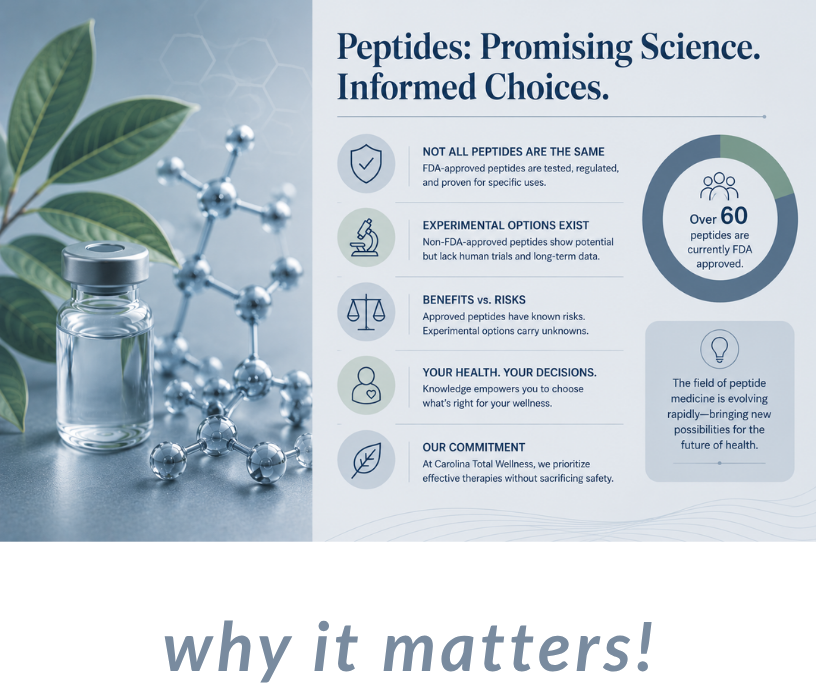
The human body, and the bacteria in our bodies, produce thousands of peptides. Peptides are powerful, short chains of amino acids that act like signaling molecules in the body, supporting healing, metabolism, and hormone balance. Researchers have known about peptides for decades and over 60 are currently FDA approved for use [4]. In functional medicine, they’re gaining popularity for root-cause wellness, but not all are equal.

FDA-approved peptides undergo rigorous testing in large clinical trials for safety, dosing, and efficacy. The FDA ensures consistent manufacturing and monitors side effects.

Common examples:

• GLP-1 agonists (e.g., semaglutide/Ozempic® or tirzepatide/Zepbound®): Used for type 2 diabetes, sleep apnea, and weight loss by mimicking gut hormones to regulate blood sugar [1,2].

• Teriparatide (Forteo®): Builds bone for osteoporosis [3].

• Leuprolide(Lupron®): Hormone therapy for prostate cancer or endometriosis [3].

Non-FDA-approved peptides (compounded or research-grade) lack this oversight. They’re not tested in humans for specific uses and are sourced from laboratories or compounding pharmacies with variable purity and potency risks. Batch testing has shown a wide variety of potency and contamination between supplies.

Common types:

• BPC-157: Gut healing, tissue repair (investigational)

• Thymosin Beta-4: Wound healing, inflammation

• Ipamorelin/CJC-1295: Growth hormone support for anti-aging and muscle recovery

These peptides are sometimes used off-label in integrative clinics for longevity or injury support, but evidence remains preliminary. Many of the proposed benefits are extrapolated from rodent studies, and the long-term effects in humans remain largely unknown [5].

Approved peptides offer proven benefits with known risks. Non-approved peptides may help symptoms but can also carry risks related to contamination, adverse effects, inconsistent dosing, or unknown long-term outcomes.

For example, one proposed mechanism behind BPC-157 is angiogenesis, or new blood vessel formation. While angiogenesis may support healing, it may also theoretically increase cancer growth in certain settings.

Bottom Line —

Peptides are a promising and rapidly emerging area of medicine, and we expect to see many more become FDA-approved in the coming years [6]. However, the use of experimental, non-approved peptides carries meaningful risks.

At Carolina Total Wellness, we strive to guide patients toward evidence-based therapies and strategies that support health optimization without sacrificing safety.

References

  • Musaimi OA, Shaer DA, et al. 2017 FDA peptide harvest. Pharmaceuticals. 2018.
  • Musaimi OA, Shaer DA, et al. 2020 FDA tides (peptides and oligonucleotides) harvest. Pharmaceuticals. 2021.
  • Zhang H, Chen S. Cyclic peptide drugs approved in the last two decades (2001–2021). 2021.
  • Ji X, Nielsen AL, Heinis C. Cyclic peptides for drug development. 2023.
  • Newman D, Cragg G. Natural products as sources of new drugs over the nearly four decades from 1981–2019. 2020.
  • Papapetropoulos A, Topouzis S, et al. Novel drugs approved by the EMA, FDA, and MHRA in 2023. 2024.
  • Gattu R, Ramesh SS, et al. Peptide-bioactive hybrid molecules in infectious disease therapeutics. 2023.
  • Ayala-Aguilera CC, Valero T, et al. Small molecule kinase inhibitor drugs (1995–2021). 2021.
  • Péczka N, Orgován Z, et al. Electrophilic warheads in covalent drug discovery. 2022.
  • Dalton SE, Pietro OD, Hennessy E. FDA-approved small molecule drugs with covalent mechanisms of action. 2025.

Functional Medicine

Functional medicine is a science-based health care approach to assess, prevent and treat complex chronic disease.

Answers to frequently asked questions provided by Carolina Total WellnessLearn More

Allergy Testing & Drops

After a brief allergy test, you can begin sublingual immunotherapy (SLIT), or allergy drops under the tongue. No more allergy shots!

learn more about Allergy testing and drops provided by [VAR_PRACTICE_NAME]Learn More

About Your Visit

Learn how to prepare for your visit and what to expect at your initial consultation and at your follow-up visits with our office.

What to expect at your appointment with Carolina Total WellnessLearn More

facebook icon twitter icon instagram icon