

menu 919-999-0831

Fueling & Moving Through the Change: A Menopause Awareness Month Guide

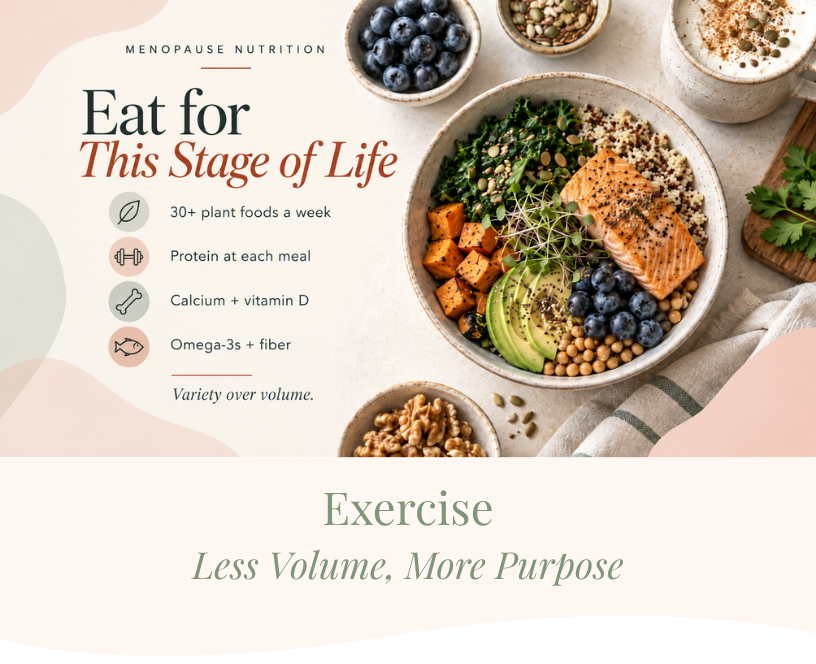
Plants first, variety over volume. Aim for 30+ different plant foods a week — vegetables, fruits, legumes, nuts, seeds, whole grains, herbs, and spices all count. Rotate colors instead of the same “safe” salad daily. Fermented foods (kimchi, sauerkraut, tempeh) support gut health, tied to hormone metabolism.

Rethinking protein. Skip the 180–200g targets aimed at bodybuilders. Simple formula: body weight in pounds ÷ 2 = a reasonable daily minimum in grams (roughly 75–100g for a 150 lb woman). Regular strength training? Lean toward the higher end. Spread it across meals — plant proteins (lentils, beans, tofu, edamame) count too, and bring fiber and phytoestrogens along.

KEY NUTRIENTS + SOURCES:

  • Calcium: dairy or fortified plant milk, leafy greens, tofu, canned salmon/sardines with bones, almonds
  • Vitamin D: fatty fish, egg yolks, fortified foods, sun exposure — many benefit from a supplement (ask your doctor)
  • Omega-3s: fatty fish, walnuts, chia and flax seeds

Fiber: beans, lentils, oats, berries, artichokes, whole grains
Women-specific research points to: heavy strength work, short strategic intensity, and less moderate “in-between” cardio.

Strength, 2–3x/week. Go heavy when you can — struggling to finish 3 reps by your 5th set is a good benchmark — but consistency matters more than the number. Options: free weights (squats, deadlifts, rows, presses), bodyweight (push-ups, step-ups, glute bridges), resistance bands, strength classes (BODYPUMP, barre, functional fitness), or Pilates. Two full-body sessions a week, 20–30 minutes each, is enough. Heavy lifting won’t “bulk you up” — that takes far more volume and food than this.

Add bone-specific jump training. Three 10-minute sessions a week of low-amplitude jumps (jumping jacks, small box jumps, jump squats) — one of the most effective moves for bone density.

Long, easy-paced sessions as your main training can blunt strength gains. Keep intervals short and infrequent — 1–2x/week, ~30 minutes: sprint intervals (30 sec hard/90 sec easy × 6–8), hill sprints, or hard bike/rower work where you can’t talk. Save easy walks and swims for recovery days.

Fuel how your body prefers. A pre-workout protein + carb snack (Greek yogurt with fruit, a shake with a banana) helps some feel steadier. Others — especially the 5am class crowd — feel strongest fasted; the science isn’t settled. Trust what works.

Don’t skip: balance/mobility work (single-leg stands, yoga, tai chi) and real rest days — recovery matters more now.

Ready to put this into practice?

Schedule an appointment with your health coach for personalized guidance on eating and exercising through this transition.
Progesterone Vs. Progestins: What Matters for Menopause Hormone Therapy

While the physicians at Carolina Total Wellness are thrilled that the use of hormone replacement therapy (HRT) in menopause has gained acceptance in conventional medicine and social media conversations, there is one area that is still causing some confusion.

If you are taking or considering taking HRT you may hear two similar-sounding words: progesterone and progestin. They are not the same—and the difference can matter for your long-term safety.

Progesterone is the natural hormone your ovaries made before menopause. The form used in many modern regimens is micronized progesterone—chemically identical to your body’s own hormone. You may hear micronized progesterone described as bio-identical progesterone.

Progestins are synthetic (lab-made) compounds designed to mimic some of progesterone’s effects. Common examples include medroxyprogesterone acetate (MPA), the progestin used in the large Women’s Health Initiative (WHI) trials.

Both can protect the uterine lining when you take estrogen (important if you still have a uterus). At appropriate doses, natural progesterone and synthetic progestins appear similarly effective at preventing endometrial hyperplasia. [1]

The WHI showed that conjugated estrogen plus the synthetic progestin MPA raised breast cancer incidence, while estrogen alone (in women without a uterus) did not and was linked to lower breast cancer rates over long-term follow-up. [2]

Later research comparing formulations suggests the progestogen type is a key factor. Observational data and reviews indicate that estrogen combined with micronized progesterone is associated with a lower breast cancer risk than estrogen plus synthetic progestins. [3][4] One meta-analysis found roughly one-third lower relative breast cancer risk with progesterone versus synthetic progestins when each was paired with estrogen. [4]

Reviews also point to a similar or possibly more favorable profile for cardiovascular and metabolic outcomes with micronized progesterone compared with many synthetic progestins. [1][5][6] Natural progesterone is the preferred choice when breast or cardiovascular risk factors are a concern. [7][6]

What This Means for You

Hormone therapy remains the most effective treatment for bothersome vasomotor symptoms and can support bone, brain, cardiovascular and genitourinary health when started in appropriate candidates. [8][9] If you have a uterus, a progestogen is required with systemic estrogen.

Choosing micronized progesterone (often taken orally at bedtime) is one practical way many clinicians individualize therapy toward a potentially better breast and overall safety profile while still protecting the endometrium. Transdermal estradiol plus oral micronized progesterone is a common evidence-aligned combination.

Therapy should always be personalized—dose, route, timing, and your personal risk factors. If you are interested in HRT or have questions about your current HRT therapy, the physicians at Carolina Total Wellness can help.

Functional Medicine

Functional medicine is a science-based health care approach to assess, prevent and treat complex chronic disease.

Answers to frequently asked questions provided by Carolina Total WellnessLearn More

Allergy Testing & Drops

After a brief allergy test, you can begin sublingual immunotherapy (SLIT), or allergy drops under the tongue. No more allergy shots!

learn more about Allergy testing and drops provided by [VAR_PRACTICE_NAME]Learn More

About Your Visit

Learn how to prepare for your visit and what to expect at your initial consultation and at your follow-up visits with our office.

What to expect at your appointment with Carolina Total WellnessLearn More

facebook icon twitter icon instagram icon